Who Brings the Oranges? The Quiet Duty That Binds a Cardiff Draconians Saturday

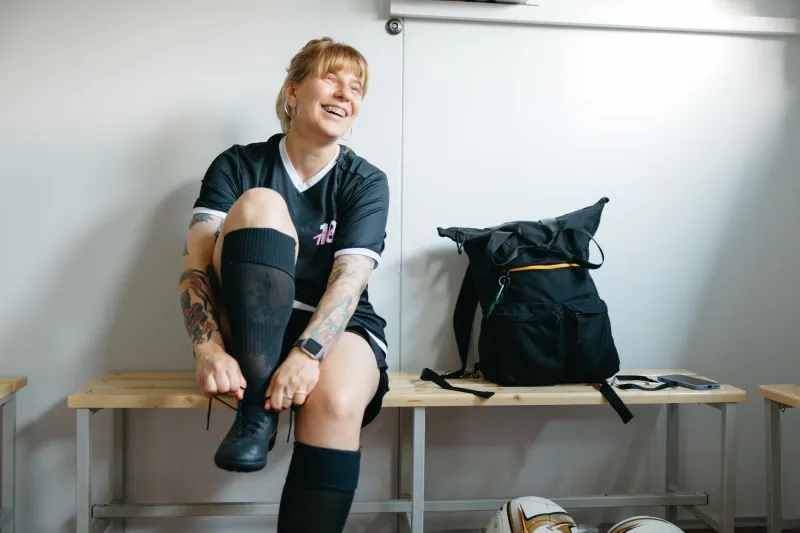
Photo: AGermanBeck, CC BY-SA 4.0, via Wikimedia Commons
The whistle goes for half-time and the first thing you notice isn't the score. It's the rustle.
Somewhere near the dugout, a freezer bag appears. Inside: a dozen oranges, already quartered, already peeled just enough, arranged in neat rows like something assembled with actual care. Within seconds there's a small crowd around it. Boots crunch. Gloves come off. And for two or three minutes, a cold Saturday in Cardiff turns into a shared kitchen table.
On paper, it's the least remarkable thing about a Cardiff Draconians weekend. In practice, it might be the most revealing.
The Worktop Before the Whistle
The orange doesn't begin at the pitch. It begins in a kitchen — often on a Friday night, sometimes at an hour nobody should be awake on a Saturday. Someone has bought the bag. Not the expensive pre-cut tubs, but actual fruit, because the club worked out long ago that a net of oranges costs less and stretches further. Someone has sliced them. Someone has remembered the small blue cool bag that lives in a cupboard and exists only for this.
In 2026 that cool bag has become a quiet piece of club infrastructure, passed between households like a baton. There is no formal rota for it. There is, somehow, always an orange.
'It's not a job,' says one of the regular slicers, a parent who has been doing it since their child's first session. 'It's just what you do before you go to bed on a Friday. You put the radio on, you cut the oranges, you go to bed. If you forget, you wake up at six and do it then.'
That last sentence is the whole culture in miniature: the acceptance that remembering is part of turning up.
The Handover at the Touchline
At half-time, the bag gets handed over. Sometimes to a coach, sometimes to a player, sometimes to a younger sibling who has been appointed for the day and takes the role very seriously. The oranges circulate. Nobody announces them. Nobody gives a speech. But watch the faces.
A new player, still working out where to stand, is handed a segment by someone whose name they don't yet know. A sub who has spent forty minutes trying to look relaxed takes one and suddenly has something to do with their hands. A parent on the touchline, frozen through, accepts a quarter and looks absurdly grateful. The orange is not really about hydration. It's about a small, repeatable act of noticing.
'You can tell a lot about a club by what happens at half-time,' says a Draconians volunteer who has watched the ritual for years. 'If it's chaotic, if nobody's thought about it, that tells you something. If there's a bag of oranges and someone making sure the new kid gets one first, that tells you something else.'
A Rota Without a Rota
The most striking thing about the orange is how little structure it has. There is no sign-up sheet pinned to a noticeboard. No group chat reminder (well, occasionally, but it's gentle). No one is named 'orange coordinator'. And yet the bag appears, week after week, across different teams, different age groups, different weather.
That's not an accident. It's a habit that has been quietly modelled and quietly copied. New parents see it happen and, a few months later, find themselves buying a net of oranges at the supermarket without quite knowing when the decision was made. Players who move up to the senior side discover the tradition travels with them.
In a city with as many sporting commitments as Cardiff, where weekends are a tug-of-war between fixtures, family and the weekly shop, the fact that this survives is worth noting. It survives because it asks almost nothing — a few minutes, a couple of pounds — and gives back something harder to price.
The Small Measure of a Club
Cardiff Draconians talk a lot about the roar. It's in the name, it's on the badge, it's in the way the touchline lifts when a tackle lands. But the roar is the loud part. The orange is the quiet part. And quiet parts are usually where culture actually lives.
In 2026, with the club's weekends fuller than ever and new faces arriving every month, the orange does a job that no welcome email can. It says: someone thought about you before you got here. It says: you don't have to ask. It says: this is how we do things.
So next time you're at a Draconians match and the whistle goes for half-time, watch the bag. Watch who carries it. Watch who gets served first. Watch the nervous newcomer take a segment and relax by a fraction. The score will matter again in a minute. For now, this is the bit that tells you what kind of club you're standing next to.
And if you're the one who remembers the oranges next week — well, that's the whole point. The bag gets handed on.